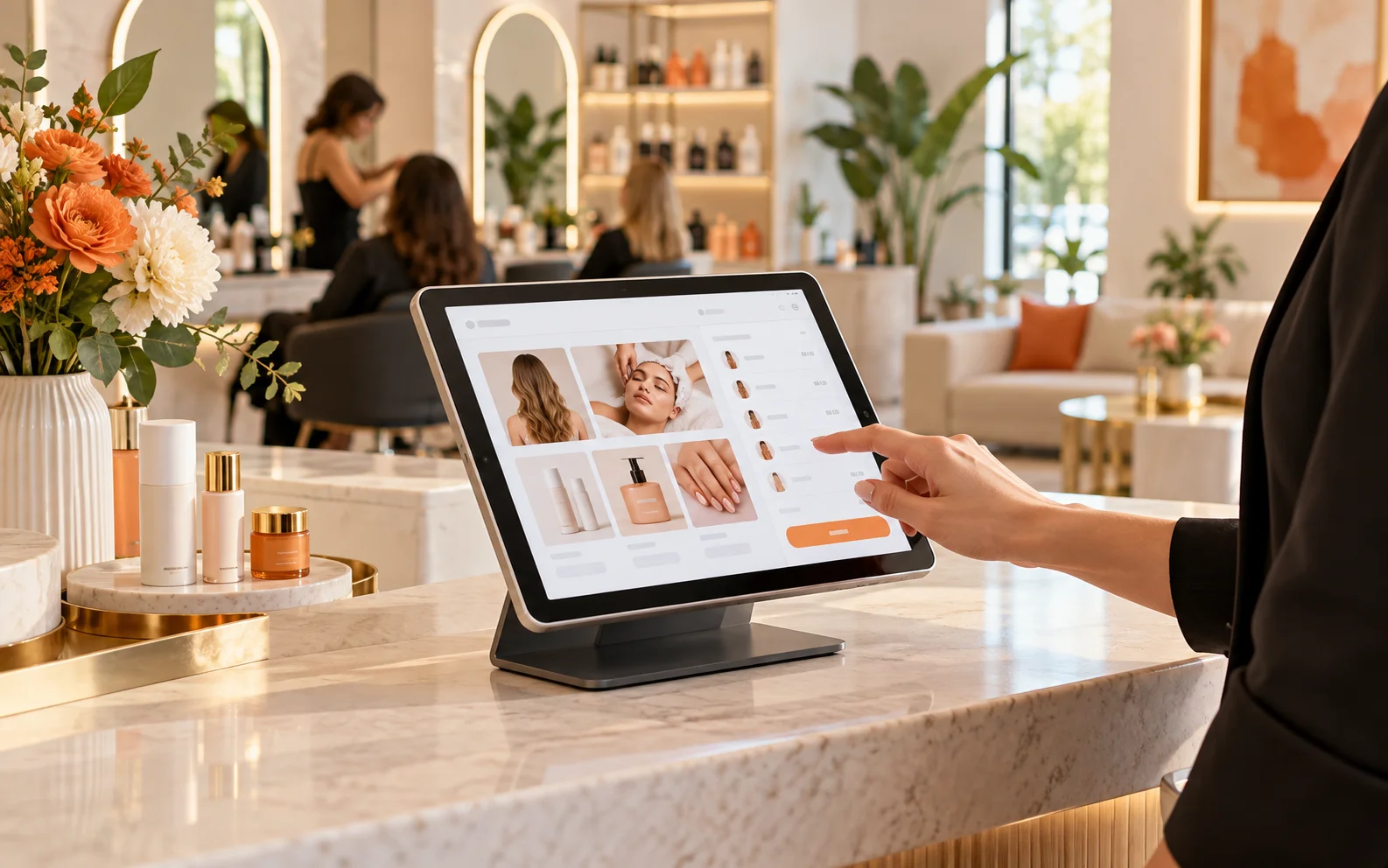
Short answer: A salon POS is built to get the bill out fast. Salon management software is built to run the business: it tracks packages, debts and commission, controls discounts and stock, and uses your data to show where you are losing customers and money. Both can issue a bill; they start from opposite goals. One wants convenience, the other wants control.
What is a salon POS?
A point-of-sale (POS) system records sales and takes payment. What matters most is speed, ease and fewer taps. Many generic POS systems come from retail or F&B and were later extended to services.
What is salon management software?
A management system also bills, but its job is to answer where every ringgit came from, why it was charged that way, and who decided. It holds the rules of your business: how packages are used, how commission is split, who may give a discount and how stock is checked.
Side by side: the same situation, handled two ways
| Situation | Typical salon POS | Salon management software (CCS Plus) |
|---|---|---|
| Sell a 10-session package, deduct one each visit | One sale; sessions left kept in notes | Sessions deducted automatically, always visible |
| RM1,000 package, customer pays RM300 | Part payment is awkward | Paid and owed shown on every bill; balance tracked on the profile |
| Three staff serve one customer | Sales usually credited to one person | Commission split automatically |
| Staff want to sell cheaper | Change the price directly | Only by discount, with a reason; above the limit, a manager's PIN |
| Out of stock, customer still wants to buy | Can't sell, or note it on paper | Sell and mark as KIV; stock stays accurate |
| One outlet short of stock, another overstocked | Each outlet on its own | Transfer stock between outlets in the system |
| Stock-take | Staff tick a stock card | Random stock-take sheet, checked on the spot with a password |
| Owner wants to know today's business | Go back to the outlet or call | WhatsApp report every night |
| Sales hit a record high | "Congratulations" | Also shows that customers aged 40–50 have fallen for 6 months |
When a POS is enough
- You work alone or with one or two staff, and you are at the outlet every day.
- You mostly sell single services, not packages or prepaid credit.
- You don't plan to open another outlet.
In that case the owner sees everything directly, and a simple, low-cost system may be the right choice.
When you need management software
- You sell packages, prepaid credit or memberships, and customers pay in parts.
- Several staff share customers, and commission causes arguments at month-end.
- You can't be at the outlet every day, or you plan more outlets.
- Sales are moving and you don't know why.
The more outlets you have, the less you can watch every bill yourself, so the rules have to live inside the system.
Isn't management software more expensive?
Compare the fee with what slips through. A package session not deducted, a debt not collected, a discount nobody approved, three products a month gone from the shelf: each is small, and each repeats every month. CCS Plus starts from RM59 a month, no contract and no cut of your sales.
Read more: POS vs management system: what salon owners must know before choosing · How to choose salon software: a checklist and 15 questions
Frequently asked questions
What is the difference between a salon POS and salon management software?
A POS is built to bill quickly. Management software also bills, but tracks packages, debts and split commission, controls discounts and stock, and analyses your data to find customer loss and leaks.
Is a POS enough for a small salon?
It can be, if you work alone or with one or two staff, are at the outlet every day, mostly sell single services and don't plan to expand.
Why shouldn't staff be able to change prices at checkout?
Because you can't tell who decided to collect less, or why. In a management system prices are fixed; selling for less needs a discount with a reason, and larger discounts need a manager's approval.
Is CCS Plus a POS or a management system?
CCS Plus is a management system. It includes billing, but its focus is packages, debts, commission, controls and reports that help the salon earn more.